
Topics Local – National & Local News Aggregator
- LV Choice – Real Estate Brokerage in Pittburgh
- First-Time Homebuyer Workshops in Pittsburgh
- MRU Instruments – National Industrial e-Commerce
- Olmos & Reynolds – Immigration Law Firm in Los Angeles
- Curated Wines – High-End Wine Shop in Los Angeles
- Treating Liver Disease – National Affiliate Products Health Site
- Top Ten Myths – National Content Blog
Client Overview
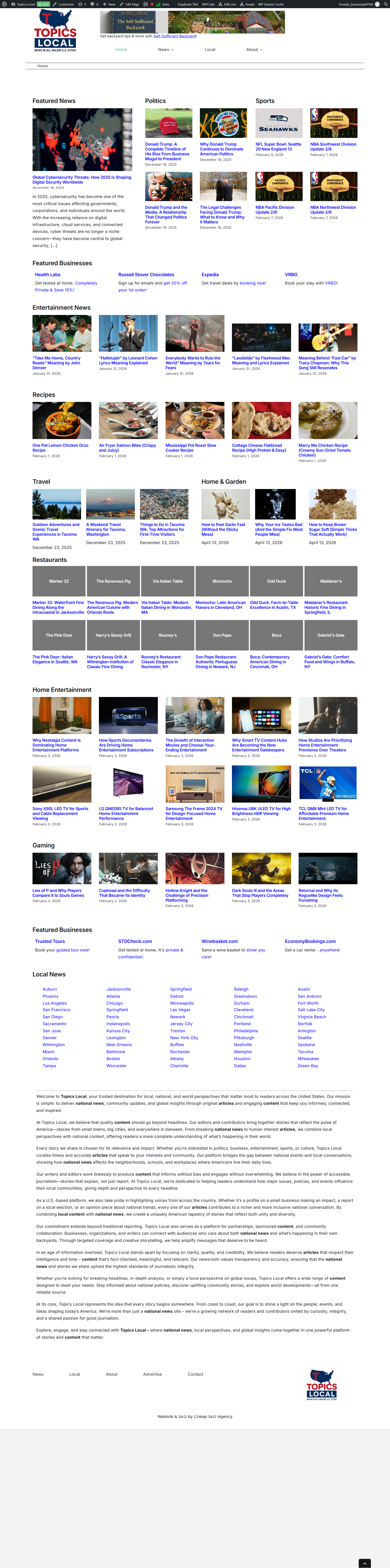
Topics Local is a national and local news website designed to cover a broad range of subjects and geographic markets. Unlike a traditional business website focused on a limited number of products or services, a news publication has the opportunity to create content around thousands of potential search queries.
Topics Local works with us as an SEO client and blog content client, with organic search playing an important role in the site’s overall business model.
The website generates revenue through advertising as well as the sale of backlinks, making search visibility particularly valuable. More organic visibility can mean more opportunities to attract readers, increase page views, expose visitors to advertising, and build the site’s overall authority and commercial value.
The project therefore requires a somewhat different approach to SEO than a conventional local business or e-commerce website.
The SEO Challenge
News websites face a unique SEO challenge.
There is virtually unlimited potential for content, but there is also enormous competition.
A local news site may compete with newspapers, television stations, radio stations, community publications, government websites, social media, national publications, and other online publishers. At the national level, the competition becomes even broader.
Search engines also have to determine which news source is most relevant for a particular query.
That means simply publishing a large quantity of articles isn’t enough.
Topics Local needs content that is:
- Relevant to actual search demand
- Structured for search engines
- Written around identifiable topics
- Useful to reader
- Capable of attracting long-tail traffic
- Appropriate for both local and national searches
The combination of SEO and ongoing blog content provides the foundation for that strategy.
Turning Content Into an SEO Asset
For Topics Local, every article represents another potential entry point from Google and other search engines.
A traditional business might have dozens or hundreds of pages that can rank organically.
A news publication can potentially have thousands.
This creates an opportunity to build a very large organic footprint over time.
Industry data illustrates the scale of the news SEO environment: one current database tracks more than 1,500 English-language local news websites, with the median site ranking for more than 3,000 organic keywords. The database also identifies advertising platforms as common revenue sources among these publishers.
For Topics Local, the strategy is therefore centered on continually expanding the number of relevant searches for which the website can appear.
Blog Content as a Core Part of the Strategy
Blog content is particularly important because it gives Topics Local the ability to continually expand its coverage.
Rather than relying on a fixed set of evergreen pages, the site can publish content around new developments, trends, events, community subjects, consumer interests, and other topics that people are actively searching for.
Content can be developed around both local and national search intent.
Local content can focus on specific communities, cities, regions, businesses, events, and local developments.
National content can address broader subjects that have search demand across the United States.
This creates two complementary SEO opportunities:
Local search visibility + National search visibility
The result is a much broader potential audience than would be possible by concentrating exclusively on one geographic area.
Targeting Long-Tail Searches
One of the major advantages of a content-driven news website is the enormous number of long-tail searches that can be targeted.
A reader may search for a broad subject such as a national news topic, but they may also search for something extremely specific.
Examples can include:
- Local events
- Local business developments
- Community announcements
- Weather-related information
- Regional sports
- Local government news
- Consumer topics
- National business developments
- Entertainment news
- Current events
- Product and service information
Many of these searches may individually have modest search volume.
Collectively, however, they can create a substantial stream of organic visitors.
This is one of the fundamental principles behind the SEO strategy for Topics Local: build traffic through a large number of relevant searches rather than depending on a small number of keywords.
Supporting Advertising Revenue
Organic traffic has a direct relationship with the site’s advertising model.
Every search visitor represents a potential reader who can view additional pages and potentially generate advertising impressions.
That makes SEO more than a branding exercise.
The objective is to attract relevant visitors and encourage them to explore the site.
Internal linking, related content, topical categories, and strategically structured articles can all help visitors discover additional content after arriving from a search engine.
The more effectively the site connects individual articles with related subjects, the greater the potential value of each organic visitor.
SEO and the Backlink Revenue Model
Topics Local has another revenue opportunity that makes its SEO strategy particularly interesting: the sale of backlinks.
A publisher with useful content and an established website can potentially provide businesses and marketers with opportunities to obtain links within relevant editorial content.
This creates an important connection between SEO and monetization.
The site needs to continue developing content and organic visibility while maintaining a website that has value to readers and advertisers.
From an SEO perspective, this means the site should not be built solely around commercial link placements. It needs a substantial base of legitimate, useful content that gives the publication a broader identity and organic footprint.
That content provides the foundation upon which the site’s advertising and backlink revenue opportunities can develop.
Building Topical Breadth
A major component of the content strategy is topical breadth.
News publications have an advantage over narrowly focused websites because they can cover many different subjects.
Research into news publishing has identified recurring categories such as sports, weather, events, entertainment, community, business, health, breaking news, culture, and local development across news outlets.
Topics Local can use this broad publishing model to create multiple content clusters.
For example, local content can develop around a particular geographic area while national articles can create visibility for broader subjects.
Over time, these articles can form a large interconnected content network.
Creating a Larger Organic Footprint
The ultimate SEO objective is to increase the number of relevant searches that bring users to Topics Local.
This involves more than optimizing individual articles.
The broader site architecture matters as well.
Categories, tags, internal links, author pages, location pages, and related articles can all contribute to helping search engines understand the relationships between pieces of content.
A visitor arriving on one article should have logical opportunities to discover related articles.
This creates a cycle:
Publish Content → Rank for Search Queries → Attract Visitors → Expose Additional Content → Build More Search Visibility
The more content Topics Local publishes strategically, the more opportunities exist to participate in that cycle.
The Importance of Consistent Publishing
For a news-oriented website, consistency is especially important.
Unlike a traditional company website that may publish a handful of pages each year, a news publication needs a steady stream of fresh material.
Ongoing blog content allows us to help maintain that publishing pipeline.
The objective isn’t simply to increase the number of URLs on the website.
Each new article should have a reason to exist from an SEO and audience perspective.
That means identifying topics with search potential, creating useful content around those subjects, optimizing the article appropriately, and connecting it to the rest of the site’s content.
A Different Type of SEO Client
Topics Local demonstrates how SEO can function as part of a website’s revenue infrastructure, rather than simply being a customer-acquisition tool.
For a law firm, SEO ultimately supports consultations.
For an e-commerce business, it supports product sales.
For a local service company, it supports leads.
For Topics Local, organic visibility supports a broader publishing and monetization ecosystem.
Search traffic can help generate readers.
Readers can generate advertising opportunities.
The site’s content and authority can also support its backlink-sales business.
That makes SEO and content production particularly important components of the site’s overall business strategy.
Conclusion
Topics Local is an example of how an online publication can use SEO and content creation to build a scalable digital publishing business.
As a national and local news website, it has the ability to target an enormous range of subjects and geographic searches.
Our role as its SEO and blog content provider is to help turn that publishing opportunity into a larger organic search footprint through ongoing optimization and strategic content creation.
The site’s business model makes organic traffic especially valuable. Rather than relying on search solely to generate direct product or service leads, Topics Local can use organic visibility to attract readers, support advertising revenue, expand the value of its content library, and support its backlink-sales operation.
The result is an SEO strategy built around a simple but scalable concept:
More useful content creates more opportunities to rank. More organic visibility creates more visitors. More visitors create more opportunities to monetize the publication.
For a national and local news publisher, that makes ongoing SEO and content production an integral part of the business rather than simply an online marketing expense.